To people unfamiliar with growing (or with agriculture), hydroponics tends to look complicated because of its terminology. So we took on the task of creating a hydroponics dictionary to get familiar with the basic concepts in a very simple way.
With the goal of ensuring the world’s food security, Agtech in hydroponics stands out as the solution for the present and future of sustainable food production.
Our goal is for more and more people to learn about this incredible growing technique and feel encouraged to implement it not only in intensive agricultural projects, but also in their homes and urban gardens.
Let hydroponics be a technology by all and for all. Go #Agtech!
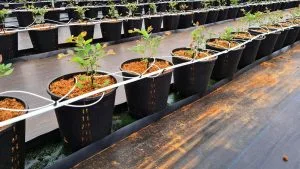
Hydroponics: A method used to grow plants using mineral solutions instead of agricultural soil. The roots receive a balanced nutrient solution dissolved in water, containing the chemical elements essential for plant development; plants can grow in a water solution or in a coconut fiber medium.
COCONUT FIBER: The name given to any substrate based on coconut husk. Many people still use the words Coco or Cocopeat when referring to coconut fiber. A 100% organic and renewable material derived from processing coconut husks.
Soilless/SoilFree: Using alternative materials as a growing substrate, and pots to hold the substrate, instead of using soil. A system disconnected from the ground. This method gives the grower better control of the rhizosphere (environment). It is an effective way to avoid soil-borne diseases and non-uniform soil, and to achieve greater irrigation precision.
Substrates (media/growing media):
Material in which plants are grown, such as coconut fiber, perlite, rockwool, peat moss, among others. They are also called growing substrates.
EC (Electrical Conductivity): A measure of how much electrical current a solution can conduct. EC corresponds to the amount of salts dissolved in the solution. EC can provide guidance when managing and monitoring nutrient solutions in closed-loop irrigation systems.
Washed material: Some plants are more sensitive to salt concentration in the rhizosphere. For these sensitive crops, it is also possible to buy coconut fiber with lower EC levels, that is, washed.
OPEN TOP BAG / Slab: The most modern technology for hydroponic growing: coconut fiber wrapped in a plastic bag (grow bag). The product is supplied compressed and reaches its final volume after hydration. This generates huge savings in labor and standardizes the growing medium.
Growing cube / Grow Cube:Some modern growers prefer to transplant mature plants into grow bags. To do this, young plants are first planted in coconut cubes wrapped in netting (the cubes are supplied compressed and expand when moistened). Once the plants have grown, they are simply placed on the grow bag (over the planting holes made in advance).
Coconut chips: A coconut structure made from the husk. These cubes are generally used to increase the drainage capacity of substrates and also help retain nutrients between irrigations, releasing them gradually.
Long coconut fibers: A combination of materials that vary in length. It is very popular as part of coconut fiber substrates to achieve a balanced mix.
Coco dust: A fine coconut structure that retains and progressively releases nutrients, preventing losses from leaching.
Perlite: A volcanic mineral. It is created when hot lava meets seawater. Manufacturing it requires a lot of heating energy. It is not considered an organic or sustainable material.
Rockwool: A synthetic material that remains very popular in hydroponic systems. Its production requires heating to very high temperatures, and it must be handled with caution (it can irritate the eyes and skin). It is not organic, and it takes thousands of years to decompose after use.
Fertigation: Mixing fertilizer into irrigation water to achieve balanced nutrition.
Aeroponics: A hydroponic growing technique that has gained enormous popularity in the USA and Canada. It suspends plant roots in the air and delivers nutrients in a fine mist.
Aquaponics: The integration of hydroponics and aquaculture. Fish waste is the main source of nutrients for plant growth instead of conventional fertilizers.
Alkaline: Having the properties of an alkali or containing alkali; having a pH above 7.
Beneficial organisms: Including ladybugs, lacewings, nematodes, and microscopic organisms that feed on or parasitize crop pests. The opposite of pests, which are organisms considered harmful to plant growth.
Biological control: Using one or more living organisms to help control an insect pest or disease.
Carbon dioxide (CO2): A gaseous compound that plants use for photosynthesis and convert into oxygen (O2), water (H2O), and plant biomass (leaves, stems, fruits, etc.).
Evaporative cooling: The process of cooling air through the evaporation of water.
Fungicide:A chemical or biological product applied to plants to prevent or cure an infection by pathogenic fungi.
Insecticide: A chemical or product used to control insect pests.
IPM (integrated pest management): Integrated pest management, the practice of using a variety of methods to manage an insect or disease instead of relying on a single method, such as using only an insecticide or fungicide. IPM can include the use of both an insecticide and a biological control agent.
Relative humidity: The amount of water in the air divided by the amount of water the air can hold when saturated at a given temperature.
Sensors: Instruments that measure environmental parameters such as temperature, relative humidity, carbon dioxide, photosynthetically active radiation (PAR) light, pH, electrical conductivity (EC), pressure, etc. Sensors are specified by their measurement ranges, accuracy, precision, and durability in given environments.
PPM (Parts per million): A unit of concentration of a nutrient, oxygen, or chemical in water. (Note: 10,000 ppm = 1 percent)
pH: A measurement of how acidic or basic (alkaline) a solution is. A pH below 7 is acidic. A pH above 7 is basic. A pH of 7 is neutral.
MilliSiemens (mS / cm): Units of electrical conductance measured with an EC meter. This EC measurement is used to estimate the fertilizer concentration of the nutrient solution and the fertigation water, to determine how strong a fertilizer solution has been mixed. There are 1,000 millimhos in 1 mho and 1,000,000 micromhos in 1 mho.